

Importing Auto Parts from China? 7 Checks Before You Approve a Bulk Shipment
Your bulk order is packed and ready to ship. Can you confirm that the parts match your purchase order, the quantities are correct, and the cartons carry the right labels? A clear auto parts pre-shipment inspection gives you evidence to review while the supplier still has time to fix any issues.
Whether you distribute spare parts, buy for a workshop network, or manage a fleet, use this checklist to agree on what gets checked and what you’ll receive before authorizing dispatch.
Confirm the order
Agree on references, product specifications and quantities.
Review shipment evidence
Request identifiable photos, measurements and test records where agreed.
Approve dispatch
Resolve discrepancies and review evidence of the corrections.
1. Confirm the OE reference and vehicle application
Create one line per part in your purchase order. Include the original equipment (OE) reference, part description, quantity, and left or right side where relevant. For parts with multiple variants, share the VIN or chassis number, engine code, or a photo of the original label. Ask the supplier to flag uncertain matches and get your approval for any proposed substitutions.
2. Agree on the exact product you’re buying
Record the agreed brand, product line, key specifications, and any packaging requirements. If you approve a sample, keep photos and written specifications so the inspector can compare the actual shipment against the same reference.
3. Ask for evidence from the actual shipment
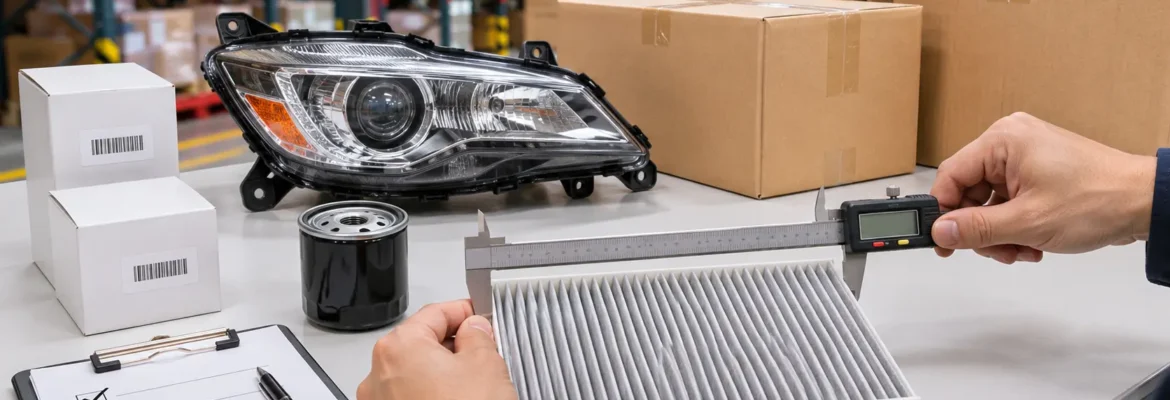
Request photos of the parts, product labels, and cartons from your order. Ask the supplier or inspector to identify the purchase order and the items shown. For a headlamp, useful photos include the connector and mounting tabs. For a cabin filter, ask for the label and the dimensions where size is part of the agreed specification.
4. Count by part number before checking the carton total
A packing list can show 500 pieces even when the mix is wrong. If you ordered 200 oil filters, 200 air filters, and 100 cabin filters, verify the count for each reference. Record shortages, overages, and substitutions against the purchase order.
5. Agree on which checks need measurements or testing
Decide before ordering what can be checked visually, what needs to be measured, and what requires test records or qualified testing. For a first order, a large order, or an order containing safety-critical parts, discuss whether to use an independent inspector. Agree on the scope, sampling plan, and acceptance criteria in advance.
6. Verify packaging and labels for your market
Check that cartons protect the parts and that the labels match your purchase order. If you need private-label packaging, barcodes, translated labels, or specific documents for your destination market, list those requirements when requesting a quote.
7. Resolve mismatches before approving dispatch
If you find the wrong part, damaged packaging, or a quantity discrepancy, record the affected part number and quantity, with photos where available. Agree on the correction and what evidence you need to verify it. Leave time between inspection and dispatch for replacements, repacking, or reinspection.
Request a wholesale quote for your parts list
Sourcing Japanese, Korean, or Chinese vehicle parts for resale or fleet use? Send Shengge Auto Parts in Guangzhou your buying list so the team can review the items and discuss your inspection and packaging requirements.
Include your company name, OE numbers, quantities per item, destination country and city, and target delivery date. If you need a sample, specific test documentation, or third-party inspection, include that in your enquiry.
For MOQ, lead times, and freight planning, see Shengge’s guide to importing auto parts from China.
Leave A Comment